
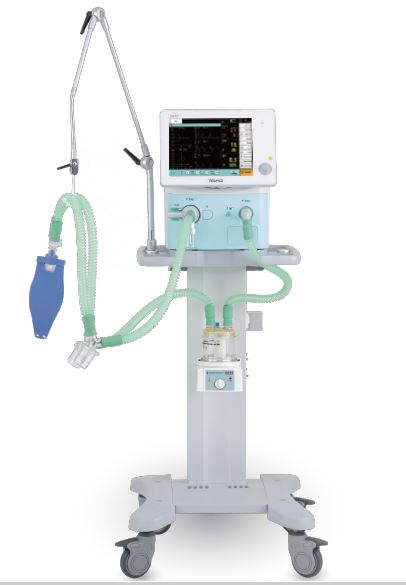
Description
Optimal patient-ventilator synchrony, increase patient comfort
- The Unique Leak Compensation System – Keep precise control on the tidal volume of each breath delivered to the patient by adjusting compensation dosage automatically
- Advanced Trigger Technique – Enhance sensitivity, avoid spurious triggering
Auto-detect and Adjust Leak Compensation
Automatically Adapt to Patient’s Breathing Pattern
Multi-parameter Monitoring
Safe Ventilation Through Whole Treatment Phase
Initial Treatment Phase
- Noninvasive ventilation mode associated with decreased intubation rates, shortened
patient stays, improved patient comfort, and a reduced risk of cross infection
- Preset patient’s height and IBW. Reduce clinician’s workload
Stable Condition Phase
- PRVC and BIVENT employ lung-protective strategies, delivering intelligent ventilation
- Comprehensive lung mechanics monitoring include compliance, airway resistance,
PEEPi and time constant
- Three waveforms & three loops with user-friendly display provide a continuous
monitoring of the patient’s condition
Weaning Phase
- Various ventilation modes enhance the weaning process
- The unique trigger and leakage compensation system safeguards each and every
patient breath resulting in smooth and comfortable breathing, avoiding extra
workload on the patient and promoting recovery
- RSBI and WOB provide accurate reference for weaning
Rehab Phase
- Data export port provides connection to hospital monitors and Patient Data
Management Systems
- Provides pressure support for the patient when spontaneous breathing is present
Technical Specification:
Ventilation Modes
- VCV(A/C) PCV(A/C) PRVC SIMV(VCV)+PSV
- SIMV(PCV)+PSV SIMV(PRVC)+PSV SPONT/CPAP+PSV
- BIVENT+PSV NIV/CPAP NIV-T NIV-S/T
Parameters
- Tidal Volume: 20~2000 ml
- Respiration Rate: 1~80 bpm
- Tinsp: 0.2~9 s
- Tslope: 0~2 s
- Tpause: 0~4 s
- I:E Ratio: 1:10~4:1
- FiO2: 21%~100%
- Trigger Sensitivity: Pressure (-20~0 cmH2O, above PEEP)
- Flow (0.5~20 LPM)
- PEEP: 0~35 cmH2O
- Psupport: 0~70 cmH2O
- Pinsp: 5~70 cmH2O
Special Procedures
- Apnea Ventilation Smart Suction Manual Breath
- Insp/ Exp Hold ETCO2 Measurement
- Nebulization Waveform Freeze
Monitoring
- Pressure Value: Ppeak, Pplat, Pmean, Pmin, PEEP
- Volume / Flow Value: Vti, Vte, MV, MVspont
- Time Value: ftotal,fspont, I:E
- Real Time Curves: Pressure-Time, Flow-Time, Volume-Time waveforms
- Pressure-Volume, Volume-Flow, Flow-Pressure loops
- Gas Monitoring: FiO2, ETCO2
- Calculated Values: Compliance(C)
- Resistance(R)
- MVleak
- RSBI
- WOB
- PEEPi
Alarm
- Paw high / low MVe high / low Circuit disconnect
- FiO2 high / low Inspiration / Expiratory tidal volume low
- High Respiration Rate Apnea AC Failure Nebulizer On
- Low Battery Air /O2 supply down High / Low PEEP
- Leakage out of range Occlusion
Technical Data
- Screen: 12〞TFT color touch screen (detachable)
- Supply Gas: O2, 28~0.6 MPa
- Power Supply: AC100~240 V, 50 Hz/60 Hz
- Communication Interface: RS-232 Port, Nurse call Port, Ethernet Port
- Dimension (WxDxH): 322 mm x 375 mm x 366 mm (Main Unit)
- 547 mm x 675 mm x 950 mm (Cart)
- Weight: 12.5 kg (Main Unit)
- 25 kg (Cart)
Superior Mobile ICU ventilator
- Comprehensive ICU ventilator including BIVENT and PRVC
- Compact, big capacity battery, no air compressor, intra-hospital mobility
- Flexible device configuration: equipped on a trolley, bed or ceiling pendant
Cost Effective Solution
- Unique metal-based, autoclavable, heated exhalation valve
- Built-in flow sensor, non-consumable design
- Upgradeable ventilation system software, with an available USB port


